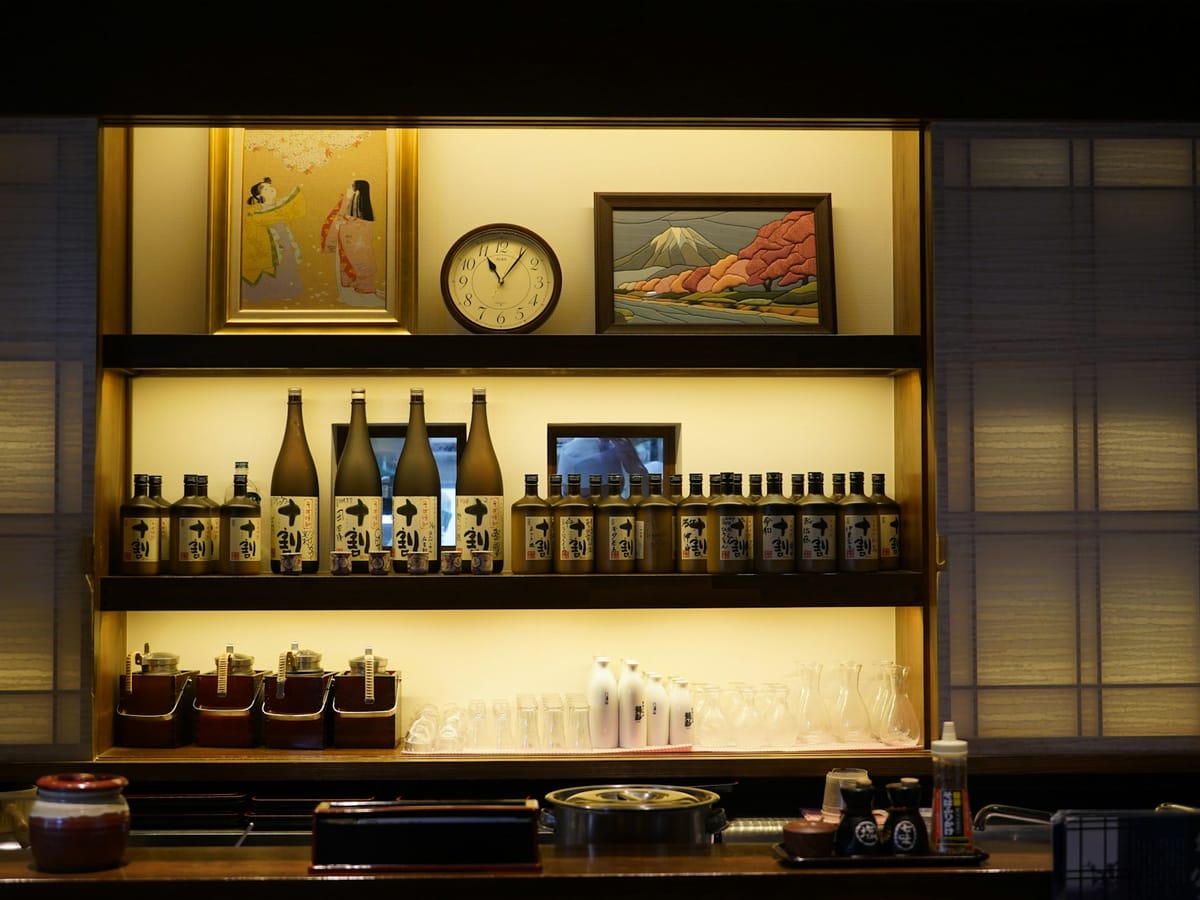
According to Suntory, the house's whisky, Japan's first, turned one hundred in 2023. The Bebidário catalog has four Japanese whiskies, three from Suntory and one from Nikka, and they cover very different styles: a light blend made for the highball, a grain whisky, a blend of more than ten components and a full-bodied blend at 51.4%. Before them, a bit of history and what Japanese rules require on the label.
How it began
Suntory was born in 1899, in Osaka, when Shinjiro Torii began selling Western-style wines and spirits. According to the company, in 1923 construction began on the Yamazaki distillery, Japan's first malt whisky distillery, near Kyoto, and in 1929 came Shirofuda, which Suntory calls the country's first authentic whisky. In 1937 came Kakubin, the one in the square bottle.
Nikka tells the other half of the story. Masataka Taketsuru studied at the University of Glasgow from December 1918, visited Scottish distilleries and returned to Japan in November 1920. In June 1923 he joined Kotobukiya, Suntory's former name, and worked at Yamazaki, which was completed in November 1924. He left in 1934, founded Dai Nippon Kaju, the future Nikka, that same year, and completed the Yoichi distillery, in Hokkaido; the first Nikka Whisky came out in 1940. Then came Miyagikyo (1969), from Nikka, and Chita (1972) and Hakushu (1973), from Suntory.
What makes it different
Since April 2021, a rule from the Japanese producers' association (Japan Spirits & Liqueurs Makers Association) has applied to the use of the name "Japanese whisky": malt is mandatory in the recipe, water from Japan, saccharification, fermentation and distillation at a Japanese distillery, at least three years in wooden casks of up to 700 liters inside Japan, and bottling in the country, at a minimum of 40%. For the four labels in the catalog, each house builds its blends with whiskies from its own distilleries. Suntory uses malt from Yamazaki and Hakushu and grain from Chita; Nikka combines Yoichi and Miyagikyo with grain whisky from a Coffey still, equipment it installed in 1963. And there is mizunara, Japanese oak, present among Hibiki's casks.
The highball
Suntory says it popularized the highball, whisky with sparkling water, in Japan soon after opening Yamazaki; in the 1950s it became the drink of bars and izakayas, and in the 2000s the company relaunched whisky in the country with the highball at the center. That is why it is a good way to get to know the style, and the house recipe for Toki is one part whisky, three parts chilled sparkling water, ice and lemon peel.
How we organized it
The order goes from the lightest label to the most intense, based on the profile in the spec sheets. The flavor comes from the pyramid, built with the producers' tasting notes. The price is from the five stores surveyed in Sep 2026: Toki and Nikka From The Barrel were not on sale at any of them, and Chita and Hibiki appeared at one store each.
1. Suntory Whisky Toki
Suntory Whisky Toki
Whisky · Japan
See the full profile →
Toki is Suntory's entry-level blend, launched in 2016, first for the United States. The base is malt from Hakushu and grain from Chita, with a little Yamazaki. According to the producer, it opens with green apple and honey, moves through grapefruit, grape and mint and finishes with vanilla, black pepper and ginger. It was made for the highball, in a one-to-three ratio.
2. The Chita
The Chita
Whisky · Japan
See the full profile →
The Chita is a single grain: grain whisky, mostly corn, distilled in continuous columns at the distillery that supplies Suntory's blends, bottled on its own since 2015. It ages in American oak, wine casks and Spanish oak. The pyramid is delicate: cardamom, honey and rose at the start, mint and honey in the body, wood on the finish. It is the chance to taste on its own the grain that forms the base of the house's blends.
3. Hibiki Japanese Harmony
Hibiki Japanese Harmony
Whisky · Japan
See the full profile →
Hibiki Japanese Harmony brings together at least ten malt and grain whiskies from Suntory's three distilleries, aged in five types of cask, among them sherry and mizunara. In the pyramid, rose, rosemary and wood at the start, honey, orange peel and white chocolate in the body, vanilla, apple and black pepper on the finish. The 24-facet bottle, one for each micro-season of the Japanese calendar, and the washi paper label make it the catalog's Japanese whisky for gifting.
4. Nikka From The Barrel
Nikka From The Barrel
Whisky · Japan
See the full profile →
From The Barrel, from 1985, brings together more than one hundred malt and grain whiskies, mostly from Yoichi and Miyagikyo and from the Coffey still, which go back into casks for a few months after being blended. It comes out at 51.4%, and its spec-sheet profile is the fullest-bodied and most alcoholic of the four. According to Nikka, it has wood, vanilla, dark chocolate, orange peel and cereal. It is the only one of the four bottled above 43%.
Where to start
For the highball, Toki is the label Suntory recommends for it. Chita has the lightest, most floral pyramid, and Hibiki the most complex, with more notes at each stage. Those who already like full-bodied whiskies have in Nikka From The Barrel the most intense profile of the four. Suntory also makes Roku Gin and Haku Vodka, for those who want to stay in Japan beyond whisky. To compare with the styles of other countries, see the guide on bourbon, Tennessee, scotch and irish.
About the prices: these are shelf prices surveyed on September 24, 2026 at the online stores of Divvino, Zona Sul, Bistek, Savegnago and Giassi, for a 700 ml bottle. They change over time and from store to store.
Drink responsibly. A highball is a long drink, not an excuse for more shots, and whoever drinks doesn't drive.
Sources: Suntory ("Heritage" timeline, Yamazaki distillery page and the text "The Innovation and Evolution of Highball Culture at Suntory", suntory.com, accessed in Sep 2026); Nikka Whisky (company history and biography of Masataka Taketsuru, nikka.com); Japan Spirits & Liqueurs Makers Association, Standards for Labeling Japanese Whisky, from February 2021, as published by Nikka; producers' descriptions and tasting notes compiled in Bebidário's spec sheets; Bebidário price survey at Divvino, Zona Sul, Bistek, Savegnago and Giassi, September 24, 2026.