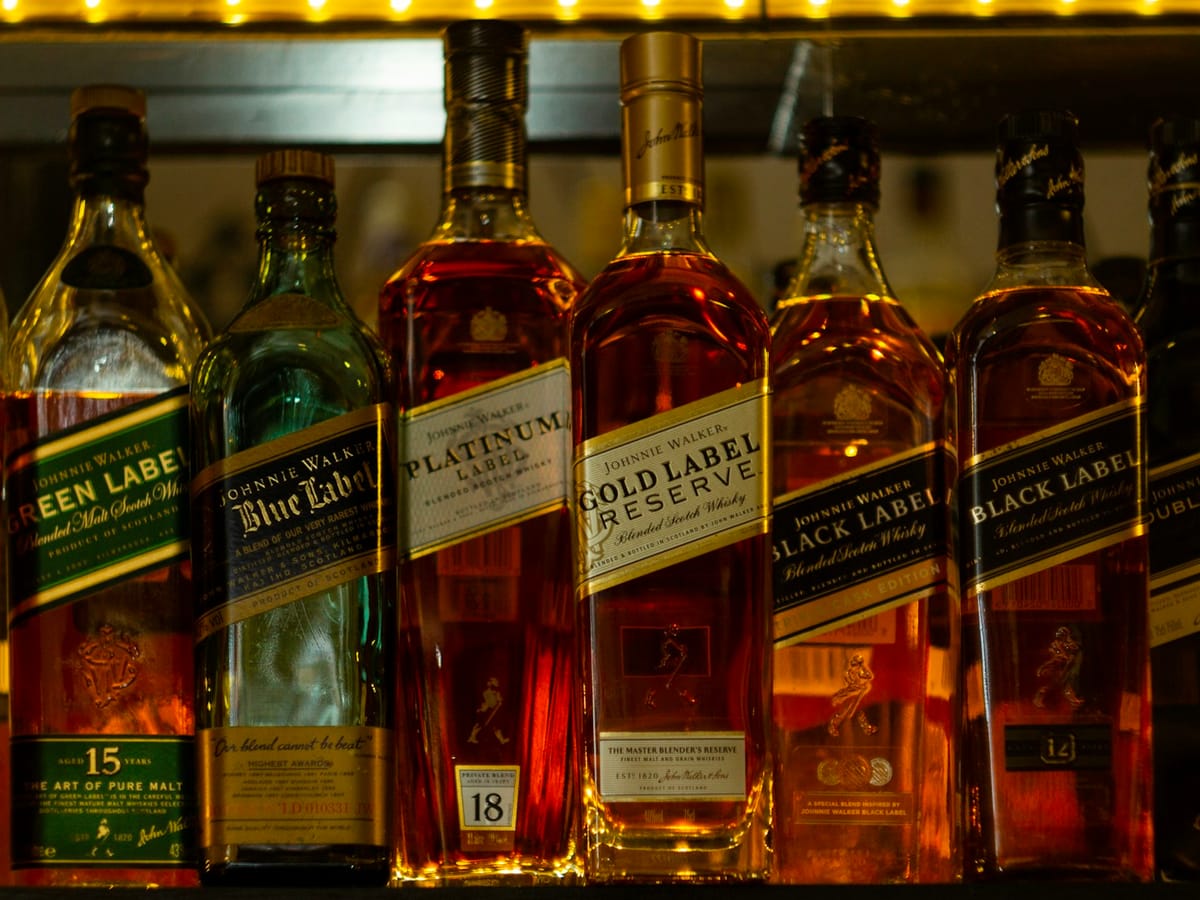
Johnnie Walker organizes its whiskies by label color, a custom dating back to when the brand, founded in 1820 in John Walker's grocery store in Kilmarnock, Scotland, began identifying each blend that way. Today the house belongs to Diageo, and the ladder goes from Red Label, made for mixed drinks, to Blue Label, with its numbered bottle. Below are the brand's nine labels in the Bebidário catalog, from cheapest to most expensive, with what changes from one step to the next.
How we organized it
The order follows the shelf price at the stores surveyed in Sep 2026. Red and Blonde have overlapping ranges, and Double Black was only on sale in a 1 L bottle. For each step, we say what the producer states (age, type of whisky, malts), the flavor according to the spec-sheet pyramid, which comes from the brand's tasting notes, and the serve the house suggests. There is no quality ranking: climbing the ladder generally means older or more selected whiskies, not one you will necessarily prefer.
1. Red Label
Johnnie Walker Red Label
Whisky · Scotland
See the full profile →
Red Label is a blend with no age statement that combines up to 35 malt and grain whiskies, among them those from the Cardhu, Caol Ila, Teaninich and Cameronbridge distilleries. In the pyramid, cinnamon and black pepper at the start, pear and green apple in the body, vanilla and a wisp of smoke on the finish. Diageo Brasil recommends it for long drinks, such as the Red Highball.
2. Blonde
Johnnie Walker Blonde
Whisky · Scotland
See the full profile →
Blonde was also made for mixing, but with a different recipe: wheat whisky and malt whisky. Its pyramid is the fruitiest in the range, with vanilla, toffee, orange peel, red fruit and apple, and no smoke. The brand's serve is the Blonde Citrus Highball: 50 ml over ice, 150 ml of lemon soda and an orange slice.
3. Black Label
Johnnie Walker Black Label
Whisky · Scotland
See the full profile →
Black Label is the first step with an age statement: single malts and grain whiskies from various regions of Scotland, all at least 12 years old. According to the producer, it has wood, toffee, vanilla and light peat at the start, smoke, pepper, green apple and pear in the body and orange peel on the finish. The brand suggests drinking it neat, on the rocks or in a highball. It is compared with Jack Daniel's in another guide.
4. Double Black
Johnnie Walker Double Black
Whisky · Scotland
See the full profile →
Double Black is Black Label pushed toward smoke. Created by master blender Jim Beveridge from the Black, it uses more Islay whiskies and west coast whiskies aged in casks charred on the inside. The pyramid brings smoke and clove at the start, peat, raisin and vanilla in the body, smoke and wood on the finish. Diageo's official store suggests a little water; to compare prices, the liter of Black Label went for R$ 179.90 to R$ 299.90.
5. Gold Label Reserve
Johnnie Walker Gold Label Reserve
Whisky · Scotland
See the full profile →
Gold Label Reserve joined the range in 2013, replacing the old 18-year-old Gold Label, and carries no age on the label. It is a personal selection by Jim Beveridge, with malt and grain whiskies. Its pyramid is among the sweetest on the ladder: honey, green apple, toffee and vanilla, with smoke only on the finish. The producer recommends it neat or on the rocks.
6. Green Label 15 Anos
Johnnie Walker Green Label 15 Anos
Whisky · Scotland
See the full profile →
Green Label is the only blended malt on the ladder: it contains no grain whisky, only single malts from Speyside, the Highlands, the Lowlands and the islands, all at least 15 years old, at 43%. Until 2004 it was called Pure Malt 15 Year Old. The pyramid opens with smoke, wood, salinity, honey and coffee, moves through cedar and finishes with peat and smoke.
7. 18 Anos
Johnnie Walker 18 Anos
Whisky · Scotland
See the full profile →
18 Anos was born in 2011 as Platinum Label, sold only in airports, and got its current name in 2017. All the whiskies in the recipe spent at least 18 years in cask. In the pyramid, malt and smoke at the start, orange peel, almond, vanilla and tangerine in the body, wood on the finish. The house suggests it neat or on the rocks.
8. Blue Label
Johnnie Walker Blue Label
Whisky · Scotland
See the full profile →
Blue Label appeared in 1992 as Johnnie Walker Oldest and got the blue label in 1994. According to the producer, only one in every ten thousand of the house's casks goes into the blend, and each bottle has a serial number. The pyramid brings black pepper at the start, nuts, orange peel, vanilla and honey in the body and smoke on the finish.
Above the ladder: Blue Label Elusive Umami
Johnnie Walker Blue Label Elusive Umami
Whisky · Scotland
See the full profile →
Elusive Umami is a limited edition created by master blender Emma Walker with Japanese chef Kei Kobayashi, at 43% and, according to the brand, from one cask in every 25,000. The pyramid has orange and red fruit, then pineapple, cocoa and blackberry, and a saline finish. The house proposes a spoonful of Oscietra caviar before each small sip.
Where to start and how far it is worth climbing
For a highball, Red Label and Blonde do the job they were created for; Blonde has no smoke, Red has a touch. To drink neat without spending much, Black Label is the first with 12 years, and Gold Label Reserve suits those who prefer honey and vanilla. Those who like smoke have Double Black and, with malts only, Green Label; see also the guide to smoky whiskies. Above R$ 600, 18 Anos and Blue Label charge for age and cask selection as stated by the producer, which does not guarantee your palate will agree. Before climbing a step, compare the pyramids on the spec sheets.
About the prices: these are shelf prices surveyed on September 24, 2026 at the online stores of Divvino, Zona Sul, Bistek, Savegnago and Giassi, for a 700 or 750 ml bottle, unless the card indicates a 1 L bottle. They change over time and from store to store.
Drink responsibly. Whisky is to be enjoyed slowly, and whoever drinks doesn't drive.
Sources: Johnnie Walker and Diageo Brasil (product descriptions, ages and tasting notes, compiled in Bebidário's spec sheets); Bebidário price survey at Divvino, Zona Sul, Bistek, Savegnago and Giassi, September 24, 2026.