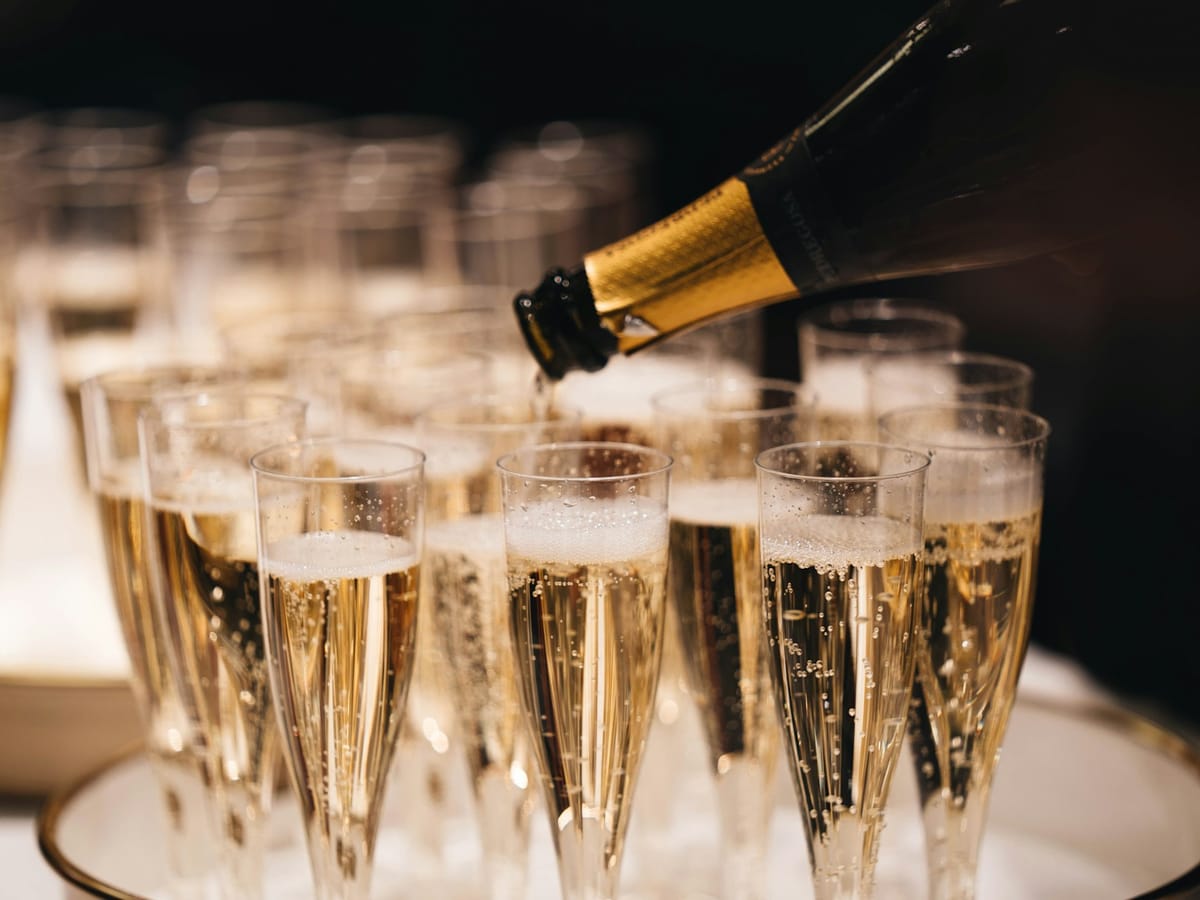
Brut, demi-sec and moscatel sit side by side on the shelf, often from the same brand, and the difference between them is, above all, the amount of sugar. Among the labels in this guide, the bruts have 9 to 14 grams per liter; the demi-secs, 35 and 38; the moscatels, 65 to 75. Below: the official scale, how moscatel is made and eight labels from the Bebidário catalog, with prices and the producer's food suggestions.
The sugar scale
In the European Union, the sweetness of sparkling wine follows fixed bands, published by the D.O. Cava and the Consorzio Prosecco DOC: brut nature from 0 to 3 g/L, extra brut from 0 to 6 g/L, brut up to 12 g/L, extra dry from 12 to 17 g/L, sec (or dry) from 17 to 32 g/L, demi-sec from 32 to 50 g/L and doux above 50 g/L. According to the D.O. Cava, what sets the band is the dosage, the liqueur d'expédition added at the end.
Brazil used its own, wider bands in the regulation of the Wine Law (Decree No. 8,198/2014): nature up to 3 g/L, extra-brut up to 8, brut up to 15, sec up to 20, demi-sec up to 60 and sweet above that. That decree was revoked in November 2025 by Decree No. 12,709, which left the standards for each beverage to Ministry of Agriculture rules. That is why a Brazilian brut with 14 g/L, such as Salton Brut, would fall under extra dry on the European scale.
What about moscatel?
Sparkling moscatel is made a different way. By the Asti method, as described in the Salton, Garibaldi and Casa Perini sheets, the must of Moscato grapes ferments only once, in a closed tank, and the fermentation is stopped by chilling: the gas stays trapped and part of the grape sugar does not turn into alcohol. The Ministry of Agriculture's Normative Instruction No. 14/2018 sets 7% to 10% alcohol and at least 20 g/L of sugar for it; the three in the catalog have 7.5% and 65 to 75 g/L.
How we chose
We included only sparkling wines from the catalog with a price in the 09/24/2026 survey and with residual sugar stated by the producer, so you can see each one's number. It is not a quality ranking: within each style, the order runs from cheapest to most expensive. Flavor and food come from the producers' sheets.
1. Salton Brut
Salton Brut
Sparkling wine · Brazil
See the full profile →
Salton's standard brut, of Chardonnay, Prosecco and Trebbiano from the Serra Gaúcha, made by the Charmat method, with 14 g/L of sugar, at the upper limit of the Brazilian band. The house points to orange peel and toast; serve between 6 °C and 8 °C, with canapés, pasta and white meats.
2. Casa Perini Brut
Casa Perini Brut
Sparkling wine · Brazil
See the full profile →
Chardonnay and Riesling Itálico from the Vale Trentino (RS), with 75 days of secondary fermentation in tank and 11 g/L of sugar. According to the producer and stores, it has pineapple, green apple and honey on the nose; the profile scores acidity 7 out of 10. Casa Perini suggests salads, cheeses, smoked fish and white meats.
3. Freixenet Cordon Negro Brut
Freixenet Cordon Negro Brut
Sparkling wine · Spain
See the full profile →
Spanish cava of Parellada, Macabeo and Xarel·lo, with second fermentation in the bottle, at least 12 months of maturation and a dosage of 9 g/L, the driest of the three. Freixenet describes green apple, pineapple and orange peel, with ginger on the finish; serve between 6 °C and 8 °C.
4. Freixenet Carta Nevada Demi-Sec
Freixenet Carta Nevada Demi-Sec
Sparkling wine · Spain
See the full profile →
The medium-sweet version of Carta Nevada, a cava of Macabeo, Xarel·lo and Parellada in equal parts, with nine months of aging and 38 g/L of sugar. The neck reads "Medium Dry". The producer mentions peach, apple and honey; serve between 6 °C and 8 °C.
5. Chandon Riche Demi-Sec
Chandon Riche Demi-Sec
Sparkling wine · Brazil
See the full profile →
A white demi-sec from Chandon, of Garibaldi (RS), by the Charmat method, with at least four months in tank and 35 g/L of sugar. The pyramid shows tropical fruit, fig, vanilla and honey. Chandon recommends it with spicy dishes, blue cheeses and desserts. The house also has the rosé Chandon Passion, with the same 35 g/L, designed to be served over ice.
6. Salton Moscatel
Salton Moscatel
Sparkling wine · Brazil
See the full profile →
Moscato from the Serra Gaúcha in a single fermentation stopped by chilling: 65 g/L of sugar and 7.5% alcohol. Salton describes ripe banana, lemon and pear. Serve colder than the brut, between 4 °C and 6 °C, with appetizers, blue cheeses and desserts.
7. Garibaldi Moscatel
Garibaldi Moscatel
Sparkling wine · Brazil
See the full profile →
From Cooperativa Vinícola Garibaldi, with Moscato Branco and Moscato Giallo, by the Asti method in pressure tanks, with 65 g/L and 7.5% alcohol. The pyramid has green apple, honey, passion fruit and vanilla. The cooperative suggests 4 °C to 6 °C, with fruit, ice cream, cakes and cheeses.
8. Casa Perini Moscatel
Casa Perini Moscatel
Sparkling wine · Brazil
See the full profile →
The sweetest on the list: 75 g/L, with 7.5% alcohol, from a fermentation of about 25 days stopped by chilling. According to Casa Perini, peach and grape. The house steers clear of the obvious dessert and suggests pork with jellies, caramelized vegetables and panettone.
Which to buy
To open before dinner and go with savory snacks, fish and chicken, go for brut. For spicy food, blue cheese or dessert, demi-sec. For cake, fruit and ice cream, or for those who want less alcohol in the glass, moscatel.
About the prices
The prices are shelf prices, surveyed on 09/24/2026 at Divvino, Zona Sul, Bistek, Savegnago and Giassi, 750 ml bottle. The range runs from the lowest to the highest price found; when only one store had the label, we show its price. Prices change over time and from store to store.
Drink responsibly.
Sources: D.O. Cava, category pages by sugar content; Consorzio Tutela Prosecco DOC, "Types" page (European sugar scale); Decree No. 8,198/2014, art. 35, and Decree No. 12,709/2025, on the Presidency of the Republic portal; MAPA Normative Instruction No. 14/2018, table for sparkling moscatel wine; producers' technical sheets (Salton, Casa Perini, Freixenet, Chandon, Cooperativa Vinícola Garibaldi); all consulted on 09/24/2026; Bebidário price survey at Divvino, Zona Sul, Bistek, Savegnago and Giassi (09/24/2026).